Living Plate
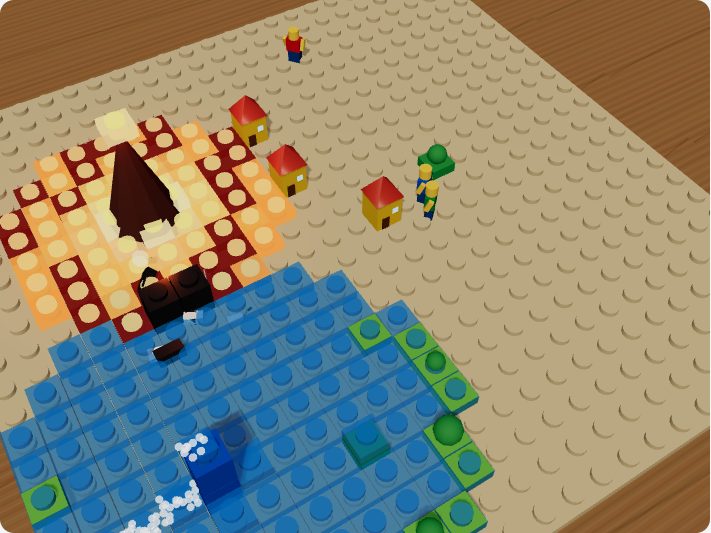
Put bricks on a plate. Each colour is a rule. Bring it to life and the world runs: water flows, plants grow, lava spreads.
 Play it
The question
If the bricks follow simple rules, do children build a world instead of an object?
A model car is finished when it is built. A plate where water runs downhill and lava burns what it reaches is never finished: you build a dam, the river finds another way, you move a brick. I want to know whether that pulls children into building places, with rivers, walls and villages, and whether ten children make ten different worlds.
The idea on a real plate
The version I have in mind uses real bricks on a real baseplate. A phone held over it reads the plate and draws the living world on top of the bricks in the camera picture. Move a brick with your hand and the water flows around it. The version here is the same rules on a screen, built to find out whether the rules are worth the camera.
What you do
You tap the plate to put a brick down, tap again to stack it (up to four high), or drag to paint. Then you press Bring to life and keep changing things while it runs. There are four ready-made plates, each with a one-line story (Volcano and village: "The lava is coming for the village. Build a wall, or bring water to it."), and four goals you can try: make a lake, grow a forest of 15 trees, make new land, and keep every house safe from a volcano for 30 seconds.
| Blue | A spring. Water flows downhill and spills off the edge of the plate, unless something walls it in. |
|---|---|
| Grey | Stone. A wall. Stacking it higher holds deeper water. |
| Green | A seed. It spreads where the ground is wet and grows into bushes, then trees. |
| Red | A volcano. Slow lava that burns plants and houses. |
| White | Ice. It melts into water when lava comes near. |
| Yellow | A house, with a villager who walks around it and runs when lava comes close. |
Where lava meets water, it turns into new stone.
Choices I made
- Six colours and no more. Every rule has to be guessable from one look at the plate, and each colour only does one thing.
- Height matters. Stacking is the only way to make a deep lake or a wall the lava can't climb, so building up is part of the play, the way it is with real bricks.
- The same plate always gives the same world. That keeps the rules testable, and a plate that worked once will work again.
- Changes have to be visible. In the first version the world changed quietly and you missed it. Now water and lava are see-through plates that pop on layer by layer, a burning house falls apart into bricks, and villagers run.
What I checked
- The rules do what a child would expect. A test checks each one: water makes a lake only when walled in, seeds stay alone without water and become a forest next to a spring, lava and water make stone, ice melts near lava.
- A wall saves the village. On the volcano plate, houses burn without a wall, and with a stone wall none burn.
- Ten different plates, filled the way a child might, give ten different worlds after 30 seconds.
- Every ready-made plate shows something happening within a minute, and every goal can be reached.
- I built a ring of stone by hand with a spring inside. It became a lake and the lake goal ticked.
What I don't know yet
- Whether children find the rules on their own, or need them explained.
- Whether it holds attention past the first volcano, or turns into something you watch instead of something you build.
- Whether a phone can read a real plate. The camera part is not built: finding the plate, reading the colour on every stud in ordinary room light, and drawing the world on top of the bricks.
How I'd test it
- Who
- Six to eight children aged 6 to 10, one at a time or in pairs, fifteen minutes each.
- Setup
- Start on the volcano plate with no instructions beyond "press Bring to life". After five minutes, clear the plate and let them build from nothing.
- What I watch
- Does the child build a wall when the lava comes, without being told? On the empty plate, do they make places (a lake, a river, a village) or scatter bricks? Do they keep changing the world while it runs? What stories do they tell out loud?
- What counts as a yes
- Most children build something on purpose on the empty plate, and a screenshot of each plate after ten minutes looks clearly different from the others.
- What it decides
- If they build worlds, the rules are the toy and the camera is worth building. If they only watch, the rules need more for the child to do before any camera work starts.
Next steps
- Run the sessions above.
- A camera test, the riskiest part, done before any drawing on top: photograph a real baseplate with single-stud bricks in the six colours under ordinary room light, and measure how many studs a phone reads correctly. Brick Beats needs the same reader, so one test answers it for both.
- Only if the reader is reliable: draw the world over the camera picture, starting with water.
Where it could go
A campaign mode on top of the free plate: it teaches the rules one at a time, works as a tutorial and tells a story as it goes. Weekly missions, and new materials over time, each one a new rule to build with.
Further out: build your own city from bricks and use a phone or tablet to turn it into a living city in AR.
What already exists
I looked after building it. The rules aren't new, and neither is reading coloured blocks with a camera:
- Bloxels (2015): a 13 by 13 board of coloured blocks, each colour a role in the game, photographed by a tablet into a playable level. The closest match to "the colour is the rule".
- The Powder Toy and Sandspiel: falling-sand games with water, lava, plants and fire.
- AR Sandbox (UC Davis) and Tangible Landscape (NC State): water projected onto a surface you shape by hand, flowing downhill.
- MIT CityScope: a camera reads a grid of LEGO colours as cell types for city simulations.
- LEGO Hidden Side (app closed on 1 January 2023) and Fusion Town Master (2014 to 2015): brick and camera play that didn't last, with scanning named as a weak point in reviews.
What I haven't seen is a living world running on ordinary bricks on a baseplate, drawn in AR on the real plate. Those closed attempts are the reason the camera test comes first in the next steps.
A personal project, not made, endorsed or affiliated with the LEGO Group. LEGO is a trademark of the LEGO Group. Products named above belong to their owners; every link was checked on 6 November 2026.